Bulk WhatsApp Marketing: Complete Guide for Businesses in 2026
 Cloud WhatsApp Team
WhatsApp is where your customers already spend their day. Bulk WhatsApp marketing lets you reach all of them with one campaign — offers, reminders, product launches and updates — in a channel they actually open. This guide explains how it works in 2026, what the rules are, which campaigns work best and how to choose the right WhatsApp marketing software.
What is bulk WhatsApp marketing?
Bulk WhatsApp marketing means sending the same (or personalised) WhatsApp message to many customers at once, as part of a planned WhatsApp campaign. Instead of copying a message to contacts one by one, you upload your customer list, pick an approved message template, add images, videos or buttons, and send it to everyone in a few clicks.
Done properly, it is not spam. Customers who have agreed to hear from you receive useful messages — an order update, a festive offer, a payment reminder — on the app they check many times a day. That is why bulk WhatsApp messages usually get noticed far faster than email or SMS.
Why businesses are moving to WhatsApp marketing
Every business is competing for attention. Emails land in promotions tabs, SMS feels impersonal, and social posts disappear in the feed. WhatsApp solves these problems in a few ways:
- It is personal. Your message sits in the same chat list as the customer’s friends and family.
- It is conversational. Customers can reply instantly with a question or an order, so every campaign can start a sale.
- It is rich. You can send product photos, videos, PDF brochures, locations and tap-to-act buttons in one message.
- It is trackable. With good WhatsApp marketing software you see exactly which messages were delivered, read and replied to.
- It is global. One platform can reach customers in 171 countries, so local shops and exporters can use the same tool.
How bulk WhatsApp messages work
There are two ways businesses use WhatsApp: the free WhatsApp Business app and the WhatsApp Business API. The app is built for one person replying on one phone. It is not designed for sending to large lists, and blasting messages from it — or from unofficial “bulk sender” tools — is the most common reason numbers get blocked.
For bulk WhatsApp marketing, businesses use the WhatsApp Business API through a provider such as Cloud WhatsApp. The flow looks like this:
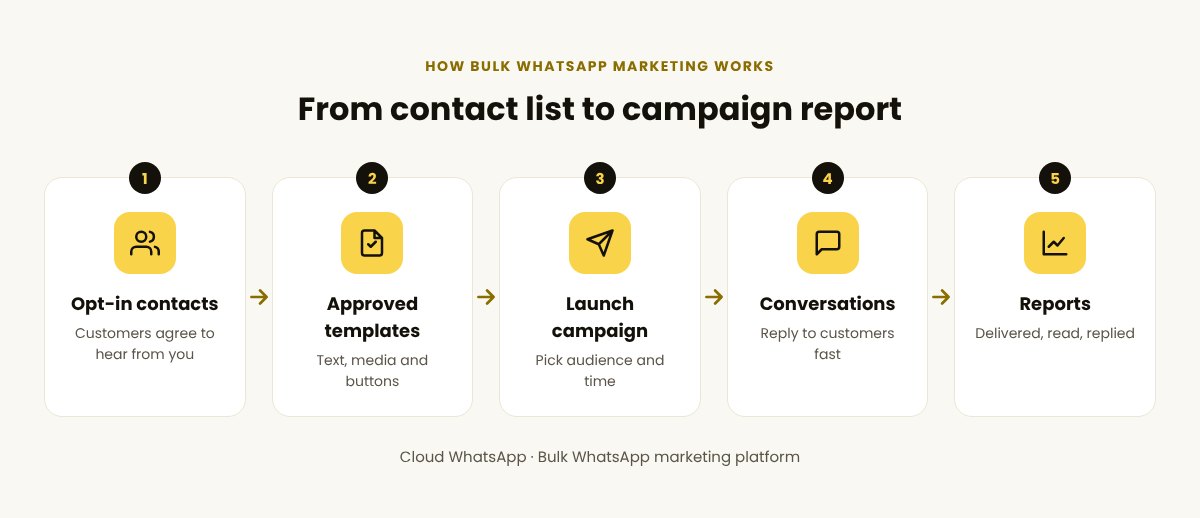
- Opt-in contacts. Customers agree to receive messages from you — through your website, checkout, a QR code or a click-to-WhatsApp ad.
- Message templates. Business-initiated messages use templates approved by WhatsApp. Templates can include variables like the customer’s name, plus media and buttons.
- Campaign. You choose the audience, the template and the send time, then launch.
- Conversations. When a customer replies, a customer-service window opens and your team can chat freely.
- Reports. You see sent, delivered, read, replied and failed for every number.
WhatsApp charges businesses per template message, and the rate depends on the customer’s country and the message category (for example marketing, utility or authentication). Your provider’s plan sits on top of that — see Cloud WhatsApp pricing for current plans.
Types of WhatsApp campaigns you can run
Most businesses start with promotions, but the best results usually come from mixing promotional and helpful messages. Here are the campaign types that work for almost every industry:
| Campaign type | Example | Best for |
|---|---|---|
| Promotional offer | “Flat discount on all plans this week — tap Shop Now.” | Retail, e-commerce, education, services |
| Festive campaign | Diwali, Eid, Christmas or New Year greetings with an offer | Any business with seasonal sales |
| Product launch | Photo or video of a new product with a “Know more” button | Brands, real estate, automobiles |
| Reminders | Payment due, appointment tomorrow, renewal coming up | Clinics, finance, subscriptions |
| Transactional updates | Order confirmed, shipped, out for delivery | E-commerce, logistics |
| Re-engagement | “We miss you — here’s something special to come back.” | Customers inactive for a few months |
How to plan your first WhatsApp campaign
A good first campaign is small, focused and easy to measure. Follow these six steps:
- Pick one goal. More bookings, more repeat orders or more demo requests — not all three.
- Choose the right audience. Start with customers who bought recently or asked you a question. They are the most likely to respond.
- Write a short, clear message. Lead with the benefit, use the customer’s name, and keep it to a few lines.
- Add one strong call to action. A “Shop Now”, “Book a Slot” or “Call Us” button beats a long list of links.
- Send at the right time. Avoid late nights and early mornings. Test a few time slots and compare.
- Measure and repeat. Compare read and reply rates, keep what works, and change one thing at a time.
Need help writing the message itself? Our guide on how to send bulk WhatsApp messages safely and effectively includes ready-to-use template examples.
Choosing the right WhatsApp marketing software
The software you choose decides how easy, safe and measurable your campaigns are. Look for these features:
- Official WhatsApp Business API access — no risky unofficial tools
- Easy contact upload from Excel or CSV, with groups and tags
- Template creation with images, videos, PDFs and buttons
- Personalisation with customer names and other details
- Campaign scheduling
- Crystal clear reports: sent, delivered, read, replied and failed per number
- International sending if you have customers abroad
- Support from a real team when you need it
Cloud WhatsApp includes all of these in one dashboard, along with Bulk SMS, notifications via API and a white-label reseller panel for agencies.
Mistakes to avoid in bulk WhatsApp marketing
- Messaging people who never opted in. It leads to blocks and reports, which lower your number’s quality rating.
- Sending too often. A useful message every week beats three offers a day.
- Using the same message for everyone. Segment by interest, location or last purchase.
- Long walls of text. Keep it short and let the image or button do the work.
- No way to opt out. Always let customers say “STOP” — it protects your number.
- Ignoring replies. Every reply is a warm lead. Answer quickly.
Running a small business? See 10 WhatsApp marketing strategies for small businesses for ideas you can use this week.
Frequently asked questions
Is bulk WhatsApp marketing legal?
Yes, when you use the official WhatsApp Business API and only message customers who have agreed to receive messages from you. Always follow WhatsApp’s business and commerce policies and local data-protection rules.
Will my number get blocked if I send bulk WhatsApp messages?
Numbers usually get blocked when businesses use unofficial tools or message people who did not opt in. With the WhatsApp Business API, approved templates and an opt-in list, the risk is much lower.
How many messages can I send per day?
WhatsApp gives every business number a daily messaging limit that starts small and grows automatically as you send good-quality messages. Your provider can show your current limit.
Can I send images, videos and PDFs?
Yes. WhatsApp templates support images, videos and documents, plus buttons such as “Shop Now”, “Call Us” and quick replies.
How much does bulk WhatsApp marketing cost?
Costs depend on the countries you send to, the message category and your plan. Contact us for Cloud WhatsApp pricing.
Start WhatsApp Marketing with Cloud WhatsApp
Send bulk WhatsApp campaigns, offers, reminders and updates from one easy dashboard, with crystal clear reports for every message.
Start WhatsApp Marketing with Cloud WhatsApp Talk to our team